News @ AsiaOne
Science and Tech school's places all filled
Overwhelming response to school that offers more hands-on learning. -ST
Sun, Nov 22, 2009
The Straits Times
[Photo: The School of Science and Technology's head of department for information and communication Loh Kwai Yin teaching pupils Jackie Lim (centre) and Lim Jia Wei how to use the GeoGebra, an interactive software use to teach geometry, during an outreach programme to educate students and parents on the hands-on learning the school offers.]
By Amelia Tan
THERE were more pupils than places available when applications opened for the new School of Science and Technology (SST), which starts in January.
About 1,140 students applied for 200 Secondary 1 places through the Direct School Admission (DSA), which allows them to gain provisional entrance based on their talents in academic and non-academic areas such as dance, robotics and niche sports.
Related links:
» Teachers not too attached to old ways
All 200 spots were filled. Candidates had to ace a video audition and attend a selection camp where they sat for written tests and performed tasks to gauge their analytical and collaborative skills.
Students at SST will study similar core subjects for the O-level exams as those in other secondary schools do. But they will do more hands-on learning, and will study subjects in other areas such as business skills, media, design, and environmental science and technology.
They will need a cut-off score of 200 points for their Primary School Leaving Examination (PSLE) to confirm their places, but the school predicts that all of its provisional students will achieve this.
If any miss the mark, there are another 200 pupils on the waiting list to take their places. The enthusiastic response means that those with stellar PSLE scores but who did not apply through the DSA are likely to be turned away.
Principal Chua Chor Huat, the former head of Ngee Ann Secondary, said the school would take in at most a 'handful' of pupils who apply after getting their PSLE results. They will be considered only if others with places give them up, and after interviews.
He said: 'We cannot increase our enrolment because we promised parents that class size will be kept to between 20 and 25 students. We feel that a small class size is best for the hands-on learning that we want to achieve.'
Aside from good scores, the school is looking for pupils who can work well with others and think creatively.
The SST is the fourth specialised independent school to open after the Singapore Sports School, National University of Singapore High School of Mathematics and Science, and the School of the Arts.
The Ministry of Education is pleased with the performance of the schools, said a spokesman. She said: 'Many students have done their schools proud with their outstanding performances in both local and international arenas.'
SST hopes to produce the next generation of entrepreneurs and inventors through a four-year programme leading up to the O levels.
The children will not be learning core subjects like Maths, Science and languages through textbooks and worksheets, but will tackle projects that get them to think about real-life scenarios that could take them out of the classroom.
For example, they could be in places like parks, bus interchanges, and hawker centres to make observations of nature, patterns in human activity, and interactions that take place.
Out in the field, they will upload their findings on MacBooks, required for each student. Back in school, they will use their data to plot graphs and chart trends, or form the content of podcasts.
Needy students will get subsidies for the laptop, which could cost more than $1,500. Mr Chua said the school chose to tie up with Apple because it can give both hardware and software support.
Assessment will be made through projects, and also pen and paper exams to prepare them for the O levels.
Parents of children who have places at SST said they believed hands-on learning would give their children an edge over their peers.
Madam Yvonne Chiang, 42, whose daughter Janice will be going to the school, said: 'There isn't much use to learning things without knowing how to apply it. I believe my daughter will learn better by doing.'
The school also has an Entrepreneurship Advisory Council led by Member of Parliament and businessman Inderjit Singh, who will provide advice on how entrepreneurship skills can be nurtured and mentorship to students on projects.
The school is temporarily situated at Clementi Avenue 6. It will move to its home at the junction of Clementi Road and Commonwealth Avenue West in January 2012.
Mr Chua said the school may eventually offer a six-year programme ending with the A levels or their own diploma, and even build a hostel at the new site.
This article was first published in The Straits Times.
Showing posts with label Education in SG. Show all posts
Showing posts with label Education in SG. Show all posts
Sunday, November 22, 2009


Sunday, November 8, 2009
Singapore University of Technology and Design (SU)
News @ AsiaOne
The university
SU will open in 2011 with an intake of 500 undergraduates and some postgraduate students. -ST
Fri, Nov 06, 2009
The Straits Times
INTAKE: The Singapore University of Technology and Design (SU) will open in 2011 with an intake of 500 undergraduates and some postgraduate students. The yearly intake will be steadily increased to 1,000 undergraduates and up to 500 postgraduates.
COURSES: It will offer four degree programmes:
Architecture and sustainable design: Students will study architecture, with a focus on environmentally conscious design, to capitalise on the growing green building movement worldwide.
Engineering and product design: Designing, developing and bringing to the market electrical and mechanical products, such as planes and cars.
Engineering systems and system design: Students will analyse, manage, design and improve complex technical systems, like urban transportation, manufacturing and energy systems.
Information engineering and design: Designing, developing and manufacturing information devices, such as digital music players and cellphones.
Related links:
» An MIT for Singapore
» Prof with a focus on innovation
CAMPUS: The university's permanent campus is being built in Changi. It will function from a temporary campus before moving to its permanent home in 2015.
FACULTY: About 50 faculty members will be on board by the time it opens.
PARTNERS: MIT has been announced as a partner of SU. MIT professors will be in charge of developing the science and technology curriculum and use design to integrate the teaching of various disciplines. They will also teach and conduct research at SU.
SU's second partner will be a Chinese university to be announced soon.
Students will benefit from overseas stints at the partner universities.
Wednesday, November 4, 2009
Improve scholarship system, not abandon it
News @ AsiaOne
'Defending scholarships but not all scholars'
Address by Eddie Teo, Chairman, Public Service Commission, at the Singapore Seminar 2009 in London on 31 Oct 09. -AsiaOne
Wed, Nov 04, 2009
AsiaOne
Below is the address by Eddie Teo, Chairman, Public Service Commission, at the Singapore Seminar 2009 in London on 31 Oct.
Related link:
» Improve scholarship system, not abandon it
Click to view relevant parts of his speech
I am very glad to see so many of you here today. When I first discussed this Seminar with the scholar organizers, the question was raised if the topics we chose would attract a large turnout. I was assured that if PSC so directs, no scholar will refuse to attend. Needless to say, I was not at all reassured by that remark. I hope that you are all here because you are keen to participate in this Seminar and not because you have been directed to do so. I look forward very much to hearing your views as much as I do to the opportunity to share my thoughts with you.
1. One Misfit
2. Two emerging trends in scholarship system
3. Arguments for why scholarships are bad
4. Scholarships are good
5. On bond breakers and attrition of public service officers
6.Good management of public service officers is key
7. Less Scholarships & More Bursaries?
8. Good Scholars - Past & Present
9. Young Scholars - Some Cause For Concern
10. Conclusion
1. One Misfit
One reason I decided on this topic was because one of the hardworking organizers gave me such a provocative list of questions on scholarships that I simply had to rise to the challenge. Another reason was a blog I read written by a former teaching scholar. It was beautifully written, full of passion and angst, relating how unhappy she was in the teaching service and how happy she now is, having completed her bond. Her blog attracted a long stream of responses, some from scholars who had broken their bonds, resonating with her sentiments and sympathizing with her plight. A few responses were critical of her complaints, but they were in the minority. Those of us who know the Public Service realize that her sentiments represent those of a minority. There are many more committed scholar public servants who are giving of their best and who regard their public service career as challenging and fulfilling.
I disagree with her overall sentiments but I agree with her on one point. She should never have been selected for teaching. PSC should not have awarded her a teaching scholarship when she showed no interest in, or passion for, teaching. She said she had no idea what she wanted in life at 19 and university overseas was a mind-blowing experience that exposed her to the endless opportunities she could have seized instead.
But what was revealing was the nature of her complaints. She did not write anything about her experience in teaching. She did not say that teaching gave her no joy and that she could not empathize with or care for the students she taught. Instead, she gave a vague hint of her dismay with office politics and her disagreement with unspecified government policies. I can understand why she chose to cite the latter rather than the former as reasons for her quitting teaching. I wish her all the best and hope she finds her true niche in life.
Next: Two emerging trends in scholarship system
2. Two Emerging Trends
My purpose today is to draw your attention to two emerging trends, both of which seek to knock down the system of scholarships unique to Singapore. (No other country in the world awards so many government scholarships to our best and brightest students).
The first trend is that of a handful of scholars feeling a little guilty that they are privileged. I am beginning to notice a few scholars asking why they are being singled out for grooming for future leadership. Why are we giving so many scholarships to top students and so few bursaries to the poor and needy? Is this false modesty on their part or guilt, or both? Is this the consequence of their awareness of ground resentment that we are becoming too elitist a society? I want to reassure this group of scholars that while we should guard against elitism and arrogance, there are good reasons why we should continue with the scholarships system.
The second trend consists of a growing number of critics - including the media, some politicians and members of the public - who seem to want the government to stop giving scholarships on account of the bad behavior of some scholars. This is more difficult to defend against because it is true that a few scholars have allowed success to go to their heads. Part of the problem lies in the sometimes excessive way we celebrate individual academic excellence in Singapore. Part of it lies in the unrealistic expectations some scholars have about their jobs in the public service.
But the fact that a handful of scholars give a bad name to the system does not mean that the system itself is rotten. In other words, we must improve the system, not abandon it.
And you have an important part to play in this because how you conduct yourself in future will either increase the resentment of the public, politicians and media or reassure them that scholars are not as bad as they are made out to be.
Next: Arguments for why scholarships are bad
3. Scholarships Are Bad
In recent years, there have been some adverse rumblings about our scholarships system. When the government spends so much money on so few people, taxpayers have a right to grumble. Not all taxpayers will be happy - but among the happy ones will be your parents. (However, as the previously cited case shows, sometimes, even those who benefit from scholarships do not appreciate their good fortune).
When the government justifies the scholarship system by saying that candidates are chosen on merit, it will invite questions on the criteria used. Are we choosing only people with high academic scores or high IQ and is this intellectual elite the best group to lead Singapore? Are we increasingly choosing people from a narrowing base? same schools, same family backgrounds, same universities? Is this elitist system producing public servants with no empathy for, and understanding of, the problems and grievances of ordinary Singaporeans?
How can they be good public servants if they think they are privileged and believe that their role is to lord over, rather than serve, the public?
Although the public resentment could be due in part to envy, it will be wrong for us to assume that there is no basis for such fears. Hence, we have tried our best to address them. Intellectual ability is a pre-requisite and is still of prime importance. It is a necessary, but not sufficient condition.
We have always looked for many more qualities beyond academic excellence, and these include integrity, commitment, leadership and soft skills. A candidate without these qualities will not do well in the public service. Mindful that we should not compromise on our principle of meritocracy, we try to ensure that we have not missed out deserving candidates by casting our net as wide as possible so that we can take in candidates from schools other than Raffles and Hwa Chong where students who do well at earlier stages of their education tend to congregate.
We pay special attention to those from a humble background to draw out those who have great potential but may not yet have the polish and finesse of their more socio-economically advantaged peers. And we encourage our scholars to study in countries other than the US and UK. In order to enhance their understanding of the ground, many scholar public servants are exposed to operational postings. This helps keep them in touch with reality. Those from a humble background will be reminded of their roots while those from a well-off background will hopefully step out of their cocoon and learn about the rest of Singapore.
But despite all our best effort, there is no failsafe method of ensuring that every one of our scholar public servants is sensitive to ground issues and truly wants to serve.
There is a risk that if scholars we recruit fail to understand and empathize with the concerns of ordinary Singaporeans, the public mood will change. Should the public, extrapolating from the few to the many, come to increasingly question whether scholars make good public servants, it will begin to withdraw its support for our scholarship system.
There is no guarantee that a future government in Singapore will have the same political courage as the present one. In most democracies, very few governments will defend a system on the basis of principle in the face of overwhelming voter unhappiness.
If the public outcry against scholarships becomes deafening, the government may one day decide to drastically cut or even stop awarding scholarships altogether.
Next: Why scholarships are good
4. Scholarships Are Good
9. Singapore has been able to build on the scholarship system started during the colonial days because we have a government which believes in meritocracy and has the political courage to act on this belief. More importantly, our people have so far joined government in celebrating academic excellence and, despite some misgivings, continue to support the idea that we should develop and nurture our most outstanding students for future leadership.
Many governments do not have our system. Some do not believe in meritocracy and offer scholarships mostly to their own kind. Some may believe in meritocracy but dare not practise it because the political culture does not allow them to do so.
Over the years, our scholars have provided the pool of leaders for the public service and elsewhere. We think we have done quite well in selecting the right people. A scholarship is not an escalator to success. For a scholar to progress in his career, hard work, demonstrated performance, and a commitment to public service are required. Not all scholars succeed, but enough do to justify the continuation of the system. It must be so. If more and more scholars break bond or fail in their studies or career, then it makes no sense to continue with the system. At the same time, the system must allow nonscholars to also rise to the top, in case they are late bloomers, or we miss them out in the earlier selection process for another reason. If we look at the top of the public service today, 16 of our 20 permanent secretaries are scholars. It shows that our system is good enough to spot potential leaders from among our scholars but flexible enough to allow for those with talent to be developed and rise to the top even if they did not start out as scholars.
Next: On bond breakers and attrition
5. Bond Breaking & Attrition
At this point, let me give you my own take on a subject that has generated controversy from time to time - bond breaking. Having spent a great deal of money and effort on a scholar, it is natural for the government to be disappointed if the scholar leaves before his bond is up.
Recruiting a scholar for the public service is more than a commercial contract. Serving the nation cannot be the same as serving a company. As a public servant you are entrusted with the lives of your fellow citizens and are supposed to deliver public goods in the public interest. You are serving Singapore, not Boston Consulting Group or Citibank. You are tasked to improve the lives of Singaporeans, not raise the bottom line of your firm by making more profits from consumers.
But do we expect 100% of our scholars to stay throughout their bond period? No.
Do we expect a significant majority of them to stay? Yes. Attrition figures are important as warning indicators to alert us if there is a problem, but they hide many things. When the various Ministries come to brief PSC and present their staff attrition figures to me, I often ask them if the attrition is a good attrition or a bad attrition.
What I mean is 'Are you losing the right people or the wrong people?'
If the best officers leave, and only the mediocre remain, the public service is in big trouble. We need enough of our best people to stay and provide a continuous flow of leaders. Likewise, with scholars. No matter how robust our selection process, and no matter how astute our PSC members are in judging people, a handful of candidates who are not suitable for public service will manage to slip through. Among them will be those who lack commitment and have little interest in the public service and merely want either the prestige or the funds that come with a scholarship to study overseas. A few may be smart, perhaps even committed, but have character flaws that show up after they join service.
If those who are unsuitable for the public service break bond, we should be disappointed that we failed to sieve them out earlier, but we should not be unhappy.
However, we still get upset with scholars who break their bond without serving even one day after they finish their studies. They have wasted the PSC's time and effort and used taxpayers' money upfront for their selfish purpose. Even if there is no scholarship quota, there is an opportunity cost to every taxpayer dollar spent on scholars. In the period 1999 to 2008, there were 9 such PSC scholars out of a total of 791 scholarship holders recruited. Although this is a low attrition rate of 1%, we would like to see it go down to as close to zero as possible.
There are also some scholars who finish their bond and leave for positive reasons. Some scholars move on because they want a change in career. Nothing wrong with that especially if they stay in Singapore or contribute to Singapore in other ways. Others want to care for their young children. As a family-friendly nation, we should applaud such a motive. A few get invited to tea and become politicians. Others go on to become successful entrepreneurs and managers in the corporate world. And if they stay in Singapore or work in Singapore firms overseas, they can still make a contribution to Singapore.
Next: Good management of public service officers is key
6. Good Management is Key
However, if the Public Service is losing more and more good officers, then it ought to be concerned. Good officers often leave because they have been poorly managed. The Public Service should nurture, develop, support and reward all good officers, including scholars, so that they feel appreciated and are motivated to stay. Since public servants cannot publicize their achievements, it is all the more important that they receive signals from within the service if they have done well.
Unlike the early days, when officers assume they are doing well if nobody yells at them, young officers nowadays like to be told upfront about their performance.
My sampling of the views of the younger officers suggest to me that they yearn for better communication from the top on crucial matters such as their next posting. They say they will accept unpopular postings better if they are given a hearing and it is explained to them how the job fits into their career development and what they can learn from it.
However, Lim Siong Guan, the former Head of Civil Service, had what I thought was a good rebuttal for scholars who griped about their postings. He used to tell them that going wherever the Public Service decided to send them was the best way to develop themselves. If they were to choose their postings, many would never get out of their comfort zone and so would not grow.
Our young scholars also seem to have difficulty relating how their actual work serves the bigger purpose of the Public Service. Some also expect to meet their Minister frequently. They should realize that they may not get to meet or work directly with the Minister in the early phase of their career.
It helps if present-day Ministers reach deep into the organization to seek the views of younger officers, as the first generation Ministers like Goh Keng Swee and Lee Kuan Yew used to do. But if that does not happen so often nowadays, then the supervisors of our young scholars must make up for it by giving them enough challenging work to sustain their interest and add meaning to what they do. Hence, good leaders who manage well are crucial at all levels of the Public Service. Better still if as leader cum manager they also mentor well, because I find that some young officers need someone in authority they can turn to for advice or just someone who can give him or her a sympathetic hearing. I believe that the time spent listening is often worth investing in.
Next: Less Scholarships, More Bursaries?
7. Less Scholarships, More Bursaries?
PSC's responsibility is to develop the best talent we have, for the Public Service, regardless of the family background of the candidate. PSC is not under a budget constraint and gives scholarships strictly on merit up to the limits of worthy candidates.
Hence, giving a scholarship to a well-off student is not at the expense of one from a poorer background. We should not discriminate against those who are well-off on the grounds of social justice. It is good that students who are well-off are still attracted to PSC scholarships and public service.
It would be bad for the country if only students from poorer backgrounds consider a public service career, because it means the elite and well-off have turned their backs on society and no longer want to serve the country.
I admire those among our young who care about the growing income disparity in Singapore and are concerned about the bottom half of our society. But does this mean that we need to cut down on scholarships in order to give more bursaries? Does PSC need to be responsible for giving out grants and bursaries? My answer to both is 'No'.
Our local universities already disburse grants, bursaries and interest-free loans to those who cannot afford a university education but qualify for entry. The Ministry of Education has disbursed sufficient funds to the local universities to ensure that any needy student who gains entry into university is not deprived of an opportunity to study there. This is the government's policy.
More non-government scholarship agencies should focus on giving awards to those below the top academic tier but are good enough to fulfill the requirements for university entry, both locally and abroad.
Your organizing committee suggested that overseas education should be made accessible to all. I cannot agree that the government should fund those who are in need but do not meet our criteria, to study overseas. If they can qualify for entry into a local university, they should study in Singapore. They will get a good university education in NUS, NTU and SMU and their degrees will not hold them back if they perform well in their career, in or outside the Public Service.
In all my years in Public Service, I have never witnessed anyone being promoted or not promoted on account of his university background.
Next: Good Scholars - Past & Present
8. Good Scholars - Past & Present
Our best scholars know they have to start from the bottom in order to reach the top. They realize that to gain the respect of others, they have to gain experience before they can make a meaningful contribution. They willingly go to operational jobs and get their hands dirty. To them, each posting is a challenge and an opportunity to learn new things, even if there are low moments. They learn to take the rough with the smooth.
They know that implementation is unglamorous but vital to policy-making. They realize that they need to convince others of their competence through actual performance and should not expect their potential to propel them upwards. They know that no outcome can be due only to their own brilliance, but is the combined effort of their team. They do not look down on non-scholars because they know that many non-scholars have deeper knowledge and more wisdom.
Policy Making is Operational
Why is it important for scholars to start at the bottom? While learning the ropes and acquiring a dose of humility are worthwhile benefits in themselves, there is in fact a much more fundamental reason. Many scholars say they want to join the Management Associate Program and become Administrative Officers because they want to 'make policy'. But they fail to realize that a policy is only as good as how it is implemented.
Policy making and implementation go hand in hand. To make good policy, officers need a feel for the ground and an understanding for practical implementation constraints. You cannot conceive of good policies or make improvements to existing policies just from first principles or what you have learnt at university. You have to understand our society and economy, how things work, what can be done and what cannot. It is not enough to focus on formulating a policy without going into the details of how it should best be carried out. As a public servant, you are responsible for both.
We do not have a system where scholars think and non-scholars do. A scholar must be able to both think and do. A well conceptualized policy will fail if it is poorly implemented. A public servant who does not anticipate ground reactions and think through the impact that a particular policy will have on people is a poor public servant. An operational job enables you to learn firsthand how to implement policies and discover for yourself what the possible pitfalls are when you deal with the real world.
Recollections of Older Scholars
I asked a few Permanent Secretaries and Deputy Secretaries who had been scholars to share with me their recollection of the first few years they spent in the public service. What they told me may be of interest to you as you embark on your public service career.
A Police scholar started as an Assistant Investigations Officer, doing frontline work on suicides, thefts, molestations, etc. The posting taught him people skills because he had to work with non-scholars and developed his empathy for the public when he dealt with crime victims who sought his help.
Another started work as a Statistician where she spent her first week figuring out what she was supposed to do. She shared a phone with a subordinate, and because she was more senior, the phone was placed on her desk. But she soon realized that her subordinate needed the phone more than she did, and she therefore placed it on the other desk instead. That experience taught her that function was more important than position.
When another officer started work, he had a subordinate who was old enough to be his father. Their ideas were often at odds, but he soon realized that while he had lots of knowledge, his subordinate had a lot more wisdom. Over time, he learned to complement his own analysis with his subordinate's suggestions.
Another recalls how she had to do many things herself ? photocopying papers for meetings, receiving and serving visitors and taking lots of minutes during meetings, sometimes as many as three sets a day. She had to be very nice to the typists in the Typing Pool in order to ensure that her work did not end up at the bottom of the pile.
Next: Young Scholars - Some Cause For Concern
9. Young Scholars - Some Cause For Concern
Most of the current generation of young scholars are responsible and dedicated, but a few have a poor attitude and misplaced expectations. Some are very choosy about their postings and tend to place their personal interest above organizational interest.
Many Management Associates or MAs want to go to MTI or MOF for their first postings and get upset if they are posted elsewhere. One was so upset that he resigned, breaking his bond. When some young MAs were asked to go to NTUC to observe retrenchment exercises and learn about what impact the current economic recession is having on ordinary Singaporeans, one MA asked 'What is a retrenchment exercise?'.
Why should the Public Service be worried that some scholars are like this? First, if our scholars seek to advance only their self-interest, it indicates that they may be unable to work in a team. Much of public service work today involves teamwork because Singapore's problems are becoming more complex and involve many Ministries, and no single individual can solve them. Besides, public policy making is always the product of a group effort, of repeated discussions and revisions. From the first idea to the Cabinet paper, proposals will involve many people and countless drafts. Some young officers are not used to this and do not feel a close enough sense of ownership with the final product.
This is the way government works and is in fact a strength of our system because this is the way we gather different perspectives and considerations into a well thought-through solution. Second, if fewer and fewer young scholars desire ground postings, more and more of them may become divorced from ground issues and will start to lose their empathy for ordinary Singaporeans. The problem is not yet so widespread that it cannot be rolled back. There is still time for the Public Service to correct the trend.
Next: Conclusion
10. Conclusion
Looking at the Public Service as a whole, I think there is enough evidence for me to end on an upbeat note. I was present at a dinner with Tony Blair recently and he told us how, during his recent visits as a public governance consultant to African and Arab countries, they all invariably ask him to make them into another Singapore. It would be even better if Blair hears this from advanced countries, but it still indicates that Singapore has a good global reputation. For such a tiny country, we have not done too badly.
This well-deserved reputation is in no small degree due to our Public Service. Things work well in Singapore because we continue to have a continuous stream of able, efficient, effective and empathetic public servants. And much of that is in turn due to our scholarships system, which enables the Public Service to receive its fair share of Singapore's top talent.
I am sure that most of you are looking forward to joining and working in this Public Service. To me, it was a fascinating career - with tremendous variety and important assignments. Don't expect every day to be fascinating and important but stay contented by never losing sight of who you are serving - your people and your country.
That was enough to sustain me through 37 years in the Public Service. Not once did I think of leaving. I hope you will enjoy your future career as much as I did mine.
Let me end by quoting two friends who have been giving thoughtful advice to our Public Service. Both coincidentally make similar points in describing the job of a civil servant. One is Peter Shergold, who used to run the Australian Public Service: 'Civil service is a tough job. It is not easy to give advice fearlessly...or to deliver policy decisions uncomplainingly when that advice has not been accepted...The ability of civil service leaders to shape public policy comes at a personal cost. To a considerable extent, their influence is wielded behind closed doors. Their public voice needs to be carefully modulated. It requires leaders able to serve successive ministers with equal dedication. For all these reasons, the civil service is not a job for everyone...Yet, civil service has its distinctive rewards. It is a job that has meaning and purpose. It involves the provision of public value, not shareholder gain, with benefits delivered to citizens, not consumers. How well it is done affects, to a lesser or greater extent, the future well-being of society.'
The other is Jocelyn Bourgon, who ran the Canadian Public Service: 'The public sector is not for everyone. You must believe in the importance of the State. You must be passionate about what the Government can accomplish. Good policies can change the course of events and improve the standard of living and quality of life of citizens.'
Thank you.
Friday, September 25, 2009
Kids from HDB and private housing fare differently at school
Kids from HDB and private housing fare differently at school
MR VISAKAN Veerasamy highlighted in 'Better performers' last Saturday the statistical edge children in private housing have over the average HDB dweller.
As a former school teacher, enrichment programme founder, tuition centre owner and creator of problemsums.com, I would like to present another point of view - parents' aspirations for their children.
Related links:
» Most top students stay in HDB flats
» Students who stay in private housing 'better performers'
» Beware of breeding elitism
First, the stress threshold. Academic stress is inevitable in modern society. However, HDB-dwelling students seem to have a lower threshold.
I used to think the academic lapse of lower-income students stemmed from lack of access to quality academic programmes. Hence my tuition, enrichment and website enrolment were at special concession (or even free) for the financially challenged.
After years of dealing with students and parents from different social strata, a sad fact dawned on me. More often than not, the determinant to academic support lies not in financial capability, but in the stress threshold of students, which is set by parents.
'Too much school work', 'My child is too tired', 'I don't want too much pressure for my child' are, by and large, voices from lower-income parents. Also, most parents who prefer their children to 'rest after exams' are HDB dwellers, while parents in private housing believe in regular practice, even during school holidays.
From my experience, lower-income parents seem to set a lower stress threshold for their children, compared to parents in private housing.
Second, this stress threshold is closely related to parents' aspirations for their children, which is generally linked to their own profession.
Doctors, lawyers and engineers have higher aspirations for their offspring than hawkers and cleaners.
A convenient view of 'doctor parents producing doctor children' is that it is genetically linked.
As an educator, I believe academic achievement, at the primary school level at least, is largely driven by nurture rather than nature. If the aspiration patterns of parents do not change, doctors will continue to produce doctor children.
Our education system is fair. Should one day the income disparity broaden and elitism breed, don't blame the system.
Ken Tai
This article was first published in The Straits Times.
Better performers
'Let us not deny the obvious. Being able to afford private housing gives students a statistical edge over the average HDB dweller.'
MR VISAKAN VEERASAMY: 'At first glance, Tuesday's Parliament snapshot, 'Most top-scoring students live in HDB flats', gives the impression that students who live in Housing Board flats outperform those who live in private housing. But is that so?
The statistics given in the snapshot are as follows: About 82 per cent of Singaporeans live in public housing. More than 60 per cent of the top 10 per cent of PSLE scorers live in HDB flats. More than 50 per cent of Secondary 1 students enrolled in Integrated Programme (IP) schools live in HDB flats. But the same statistics also mean that while only 18 per cent of Singaporeans live in private housing, they account for almost 40 per cent of the top PSLE scorers and more than 40 per cent of IP school enrolment.
Let us not deny the obvious, which is that Singaporeans who can afford to live in private housing end up in better schools. Perhaps these students are more primed to succeed or can afford costly private tuition. I would not hazard to know the reasons. But one reality is immutable, going by the statistics: Being able to afford private housing gives students a statistical edge over the average HDB dweller.'
Sunday, June 7, 2009
SPEECH BY MINISTER FOR EDUCATION AND SECOND MINISTER FOR DEFENCE, DR NG ENG HEN AT THE OPENING CEREMONY OF PRE-UNIVERSITY SEMINAR 2009, ON 2ND JUNE 20
YOUR BACKPACK FOR LIFE
Introduction
Introduction
1. The last time I spoke at the Pre-University Seminar was five years ago in 2004. The theme then was “Thriving in Challenging Times”. Singapore had been through a rough patch after 9/11 and SARs, and the theme was topical. But I did not want the participants of that Pre-U Seminar to only focus on our immediate difficulties. Instead, I wanted them to look into their future, to a Singapore that was transforming before their very eyes. I wanted them to see themselves as leaders in the making, who would one day decide on the next phase for Singapore and be responsible for the well-being of Singaporeans. As it turned out, good times returned after the 2004 Pre-U Seminar. The economy rebounded with growth ranging from 7.3% to 9.3% between 2004 and 2007, compared to only 3.8% in 2003. I’m glad that I focused on the longer term issues for participants of that Pre-U Seminar. It is now five years on and the memory of that recession has diminished or forgotten altogether. But I hope what they experienced and learnt during that Pre-U seminar stays with them.
2. Here we are again in the midst of another crisis - a severe global economic crisis on a scale unprecedented since the Great Depression of the 1930s. The theme for this year’s seminar, “From Crisis to Confidence – Lessons and Opportunities”, is therefore apt.
3. By now, some of you would have concluded that perhaps it may be the norm for every generation to face a series of crises in their lifetimes – after all, we do not live in Utopia. If we take those who lived a full generation before you – those in their 60s today - certainly had their ups and downs. Born in the 1940s, they would have been cradled in their parents’ arms when the bombs fell on Singapore in December 1941. Many did not attend school because of the Japanese Occupation and the recovery phase after the War. In the short span of 25 years, they would have gone through war in 1942-45, political struggle against the communists in the 1950s, self-government in 1959, merger with Malaya in 1963, race riots in 1
1964, then separation from Malaya and independence in 1965. All these experiences would have left a lasting impression and shape the prism through which they viewed their world henceforth. Even after independence, they were not spared further shocks. The Oil embargo in October 1973, pushed prices of oil up by 4 fold within a year. When interest rates were cut simultaneously, the resultant stagflation hit economies worldwide severely.
4. In 1985, another severe recession hit. One senior Cabinet colleague of that generation recounted how he had just graduated and the job market was tough. He sent out about 100 applications hoping to find a job. This would not be tedious now, but his was the time before the Word processor and copy machines. Old-fashioned mechanical type writers were used and copies were made using thin carbon separators slipped in between sheets of papers. There was a limit to the number of copies that could be typed simultaneously – around three or at most four. Keys got stuck, and mistakes had to be ‘blancoed’ on each copy.
5. In the 90’s a momentous change took place in their lives - you were born! In the last two decades, the same events would have impacted you and the older generation. But the way you respond can be quite different. Having heard what they have gone through – war, riots, recessions - you can appreciate why their perceptions and reactions may be different from yours. We are all moulded by our past; we are products of processes that harden and hardwire our beliefs and prejudices. All these will shape our responses to life’s challenges. Forty years hence, you are likely to view events differently compared to your children........ Click the Title for more
Wednesday, May 20, 2009
I couldn't have done it without Mum

I couldn't have done it without Mum
By Veena Bharwani
HE HAS a degenerative disease that doctors said would not let him live past the age of 17.
Weighing only 30kg, he cannot dress, bathe or feed himself, and needs a machine to help him breathe.
But Kevin Lee, now 20, is a determined young man.
Not only will he graduate on Tuesday with a diploma in Internet and multimedia development, he has already been working from home as a games moderator for a software company, earning $800 a month.
He works about six hours a day.
Recognising the double act, Temasek Polytechnic (TP) will have both mother and son on the stage to receive his diploma.
Madam Tay, 52, is no stranger to TP as she has been taking her son to his classes for the past three years.
She helped him turn the pages of his books during lessons and also carried him from his wheelchair to the lecture hall.
Said Kevin on the role his mother played in his success: 'I couldn't have done it without her. She has been by my side all my life.'
He was diagnosed with Duchenne Muscular Dystrophy (DMD) at the age of 10.
DMD is a severe form of muscular dystrophy characterised by rapid muscle degeneration, eventually leading to loss of movement and death.
At the time, the family was told that he would not have many more years to live.
While she was heartbroken when she first heard the news, Madam Tay vowed to help her son fulfil his dreams.
'I wanted him to achieve as much as he can, despite his handicap,' she said in Mandarin, through a translator.
She is with him all the time. At night, she sleeps beside him and shifts his position several times to ensure he doesn't choke on his saliva.
Joker
Despite his condition, Kevin still finds ways to make his mother laugh. A teary Madam Tay said: 'He is a real joker. I've put on some weight recently. So he tells me, 'Ma, you don't need to buy a hula hoop, you have one on your tummy!' '
She quit her $1,000-a-month job at a manufacturing plant when Kevin was diagnosed with the disease.
Her daughter Lee Pei Yi, 15, is in Secondary 3. Her husband Lee Siew Kan, 53, works as a salesman to support the family.
Said lecturer N Vijayan of Madam Tay's commitment: 'She's never far away from him. Even during tutorials, she might walk out for a while, but she will come in and check on him always.'
Regarding Kevin's job at AsiaSoft Online's Playpark forum, she said: 'I have to watch him on the computer and make sure he is okay and doesn't strain himself.'
Madam Tay readily acknowledges the part played by TP in helping Kevin.
He was given extra time to complete assessments. He was also provided with a room and bed in the sick bay area to rest between classes as he would get tired easily during the day.
Since he has been unable to write for the past two years, the polytechnic arranged for a writer to write down Kevin's dictated answers during examinations.
As a Mother's Day present, he spent $500 on a Nintendo Wii game console for her.
Said Kevin: 'I just want to make her happy - she has done so much for me.'
Over the past two years, his condition has deteriorated considerably.
Said Madam Tay: 'Now he has only milk for breakfast. He has biscuits for a snack. He can't swallow anymore. He only has dinner.'
He uses the Bipap - bi-level positive airway pressure - a device that helps him breathe.
Despite the banter, one can sense her fear.
Most who suffer from DMD do not live beyond early adulthood.
She said: 'I keep myself busy so I don't think of what is going to happen to him.'
She added: 'He tells me to spend more time with my daughter as he is worried I pay too much attention to him.
'He also tells me not to be too sad when he goes.'
But now they are planning his 21st birthday in July.
'He wants a big celebration with all his friends and that's what I'm going to give him,' Madam Tay said, wiping away tears.
This article was first published in The New Paper.
First to score distinctions for all 33 of his modules

First to score distinctions for all 33 of his modules
It is a first in his polytechnic's 55-year history.
SINGAPORE Polytechnic (SP) student Kuriakin has scored distinctions for all 33 of his modules, a feat no other student from the school has accomplished since it was established 55 years ago.
The electronics, computer and communication engineering student will be graduating top of the 5,000-strong cohort of students graduating from SP next week.
For his excellent performance, the 23-year-old will be receiving the Lee Kuan Yew Award, given to top polytechnic graduates from technology courses.
His all-distinction record is made all the more impressive by the fact that he achieved it while juggling several jobs and co-curricular activities in the guitar and Rotaract clubs. He also participated in community involvement projects in the Philippines.
An Indonesian who arrived in Singapore four years ago from his hometown on Bintan island, Mr Kuriakin has worked as a waiter, sales assistant and roadshow promoter to pay off his $6,000 tuition loan and living expenses here.
The youngest of five children, he did not want to burden his parents who are still living on Bintan. His father is a mechanic and his mother, a housewife.
His efforts are even more resounding as Mr Kuriakin was not always an A-grade student. He did poorly in Indonesia's high school leaving examinations in 2004 and was denied a place at SP.
He said: 'I was the captain of my school's basketball team and neglected my studies. I saw how disappointed my parents were. During that year, my father was hurt in an accident at his workplace and until now I believe I caused it. He was distracted because he was depressed by my poor results.'
Motivated to make his parents proud, he came to Singapore to sit for his O levels as a private candidate and scored seven points.
He hopes to study robotics in the United States starting September.
He said: 'I am glad I did not give up when I did not do well in my high school exams. If I had given up, I would not be able to chase my dreams now.'
AMELIA TAN
This article was first published in The Straits Times.
His lecturers let him sleep in class
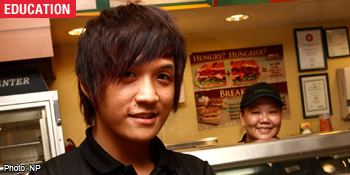
His lecturers let him sleep in class
WHEN Iwan Yuliyanto's lecturers at Singapore Polytechnic (SP) see him sleeping in class, they try not to wake him.
Because they know that unlike other students who doze off because of nights spent partying, he has a good reason.
Iwan, 21, has to work two part-time jobs so that he can afford to stay in school.
With only four hours of sleep each night, the only time the full-time student has to study is while travelling from home to school.
Yet, the Indonesian-Chinese student, who studied accountancy, still managed to clinch a grade point average (GPA) of 3.98, an almost perfect score. A perfect GPA is 4.0.
That helped him emerge as the top student in his accountancy course, beating 150 of his classmates.
Scholarship
He has also been awarded a local scholarship from Sembawang Corporation to study accountancy in one of the local universities.
Because of his consistent performance, he said his teachers did not object to him sleeping in class.
'I told my lecturers that if I sleep during lessons, it means that I already know the topic well,' he told The New Paper on Sunday.
He left his home in Bintan to come to Singapore in April 2006, when he was 18.
He said: 'I thought I would have a brighter future here.'
He also said that he was the only one in his family who had gone beyond high school.
His younger sister, 20, has a high school education, and is currently working as a bank teller in Indonesia.
His father is a businessman and his mother is a housewife. They are divorced.
Before he applied for a place in SP, the other four polys had rejected his application.
Entrance test
He felt they had done so probably because they did not recognise his academic qualification - he has a poly-equivalent certificate from a school in Indonesia.
He said SP was the only poly which allowed him to sit for the entrance test.
After coming here, he took on jobs in Subway and Starbucks to pay for his school fees, which cost $1,300 per semester.From Mondays to Fridays, he works three days in Subway and two days in Starbucks from 6.30pm to 11pm, earning $4 an hour.
While it was tough for him to juggle two jobs and his studies, he said he was inspired to succeed by his mother.
He said: 'She is a wonderful, very beautiful lady.
'I want to do her proud.'
- Audrey Tan Ruiping, newsroom intern
This article was first published in The New Paper.
Tuesday, May 19, 2009
More degree courses to be offered in polytechnics
More degree courses to be offered in polytechnics
By Pearl Forss, Channel NewsAsia | Posted: 19 May 2009 1922 hrs
More degree courses to be offered in polytechnics
SINGAPORE: A major transformation of Singapore's tertiary education sector is on the cards.
The world's leading science and engineering university, the Massachusetts Institute of Technology (MIT), will partner Singapore's Education Ministry to run the country's fourth university. And more polytechnic students will be able to obtain degrees in Singapore.
In the past, polytechnic students who wanted a degree in optometry had to go overseas.
Now, they can apply for a place in the University of Manchester, which is partnering Singapore Polytechnic to offer its degree programme here.
Tan Hang Cheong, Principal, Singapore Polytechnic, said: “The core lectures and so on will be (taught) by University of Manchester academic staff. Singapore Polytechnic staff will help support some of the teaching, especially in the clinical areas.
"We're also very fortunate to have Tan Tock Seng's Eye Institute help us in this... many of the optomologists will be helping us to do some technical training.”
Lek Xuan, Undergraduate, Optometry Degree Programme, said: “If I go overseas it will cost about S$30,000. In Singapore, it costs only about S$7000 a year.”
There are currently six different degree programmes being offered by all the polytechnics in Singapore. Besides optometry, the other degree programmes are in areas such as naval architecture, early childhood education, and food technologies. All these courses have a high practical component and are heavily subsidised.
Another six to eight reputable foreign universities are likely to offer degree programmes in local polytechnics by 2015.
The newly set-up Singapore Institute of Applied Technology will establish tie-ups with foreign universities in areas such as engineering, applied sciences, digital media and health sciences.
The institute will be a distinct entity within the Education Ministry, and will help to plan, manage and implement the different degree programmes. Thus, things like curriculum planning and admissions will come under the purview of this institute.
The institute has been given a budget of S$1.6 billion. By 2015, there should be places for about 2000 full-time students and 1500 part-time students every year.
So far, some of the universities approached include the Russell Group Universities in the UK, the Australian Group of Eight Universities -- for example, Monash University, University of Melbourne, University of New South Wales -- and the Swiss hotel schools.
Over the next 10 years, the government will spend S$3.5 billion to develop the polytechnic sector.
The full-time degree programmes are expected to last for up to two years, since polytechnic students already have the relevant foundation. It usually takes three years or more to complete the programme overseas.
Part-time courses can be expected to take up to four years, and the courses cater mainly to polytechnic students who have already entered the job market but are still keen on upgrading their skills. The degrees will be awarded in the names of the foreign universities, but they will all be taught in the polytechnics.
The Education Ministry says the universities it partners with must be reputable, well-recognised by industry, and that the degrees offered here should be no different from that offered at the parent university.
Currently, 40 to 50 per cent of polytechnic students get a degree after a diploma, and of this number, a quarter choose to go overseas.
Singapore's universities have limited places, and only about 15 per cent of polytechnic graduates get a place.
With the expanded degree programmes at polytechnics and the fourth university, about one in five local polytechnic graduates will have a shot at university education here.
Education Minister Ng Eng Hen said: “We will like to increase the number of places for all Singaporeans to obtain degrees. But as other systems have shown us, that is not the only factor that you need to consider. You can overdo it, and produce a lot of degree holders and have graduate unemployment. We can't compete on numbers. China, India will produce large hordes of degree holders. Numbers is not security, it is quality.”
The new university, which opens in 2011, will partner MIT and possibly another top ranking institute from China, whose name will be announced by year's end.
It will focus on science, engineering, information systems and architecture, with a strong research component.
Professors from MIT will play the lead role in developing the curriculum, using design to integrate all these disciplines.
The school will take in up to 4,000 undergraduates and about 3,000 postgraduates, from Singapore and overseas.
That makes it about the same size as the Singapore Management University. The Education Ministry says admission standards will be high, and fees will also be higher than in other universities, since the renowned MIT is a partner.
The Education Ministry had originally said that the new university will have an annual enrolment of 2,500 which adds up to an undergraduate population of 10,000. The intake number announced on Tuesday is smaller than originally planned. Nonetheless, with the Singapore Institute of Applied Technology, the republic is still on track to providing state-supported university education to 30 per cent of students.
Susan Hockfield, President of MIT, says, "Singapore has positioned itself superbly as an innovation hub for the 21st century. The new university is an exciting next step in our long relationship and a natural outgrowth of our shared interest in world-class science and engineering-based education, design and innovation."
There will also a third medical school in Singapore and the Nanyang Technological University has been asked to submit a proposal.
And the school will not just produce doctors, it will also focus on areas such as digitised medicine and global pandemics. The new medical school will take in between 100 to 150 students a year.
- CNA/yt
Singapore to develop 3 new tertiary institutes of excellence
Singapore to develop 3 new tertiary institutes of excellence
Posted: 19 May 2009 1158 hrs
SINGAPORE: Singapore is looking into developing three new institutes of excellence in the tertiary education sector – the Singapore Institute of Applied Technology, a new university in partnership with the prestigious Massachusetts Institute of Technology and a new medical school.
Education Minister Ng Eng Hen revealed these plans at a news conference on Tuesday.
Dr Ng said the Singapore Institute of Applied Technology will be set up as a distinct entity within the Education Ministry, which will be responsible for planning, managing and implementing degree programmes offered by foreign universities, in partnership with Singapore's five polytechnics.
The new institute will work with the foreign universities to offer degree courses from 2011. These courses will be mostly conducted in the polytechnic campuses and the foreign universities will award the degrees in their own names.
There will be places for 2,000 full-time students and 1,500 part-time students yearly by 2015. The duration of full-time courses is likely to be two years, while part-time courses can be expected to take up to four years to complete.
Senior Minister of State for Education S Iswaran will act as adviser to the taskforce appointed to look into expanding opportunities for polytechnic graduates.
As for Singapore's new university in Changi, which will open its doors to students in 2011, it will have the Massachusetts Institute of Technology (MIT) as its partner.
The university will focus mainly on the disciplines of science, engineering, information systems and architecture, and aims to be a high-quality research-intensive university.
A core team of experienced professors from MIT will play the lead role in developing the curriculum and in teaching undergraduate students. It will have an undergraduate population of about 4,000 students and a significant number of postgraduate students.
As for the setting up of a new medical school in Singapore, the Education Ministry and Health Ministry have asked the Nanyang Technological University (NTU) to submit a proposal on it.
The university has formed an advisory panel, chaired by NTU president Dr Su Guaning, to advise it on the matter.
- CNA/so
Saturday, April 26, 2008
Beware of those trigger tricks
Business Times - 26 Apr 2008
Beware of those trigger tricks
By TEH HOOI LING
SENIOR CORRESPONDENT
TURKEY mothers are good mothers. They are loving, watchful and protective. They spend much of their time tending, warming, cleaning and huddling their young beneath them. But there's something odd about how they identify their chicks - they go by their 'cheep-cheep' sound.
Other features, such as the chicks' smell, touch or appearance, seem to play minor roles in the mothering process. If a chick makes the cheep-cheep noise, its mother will care for it. If not, the mother will ignore it - or sometimes kill it.
The extreme reliance of maternal turkeys upon this one sound was dramatically illustrated by animal behaviourist MW Fox in an experiment involving a mother turkey and a stuffed polecat.
For a mother turkey, a polecat is a natural enemy whose approach is greeted with squawking, pecking and clawing rage. The experiments found that a stuffed polecat, when drawn by a string to a mother turkey, suffered an immediate and furious attack. But when the same stuffed replica carried inside it a small recorder that played the cheep-cheep sound of a baby turkey, the mother not only accepted the oncoming polecat but gathered it underneath her. When the machine was turned off, the polecat model again drew a vicious attack.
Mother turkeys are not unique in that they have this automatic reaction to the cheep-cheep sound. Ethologists, who study animals in their natural settings, have identified such regular, blindly mechanical patterns of action in many species.
Called fixed-action patterns, they can involve intricate sequences of behaviour, such as entire courtship or mating rituals. A fundamental characteristic of these patterns is that the behaviours they comprise occur in virtually the same fashion and in the same order every time. It is almost as if the patterns were recorded on tapes within the animals. When a situation calls for courtship, a courtship tape is played; when a situation calls for mothering, a maternal behaviour tape is played.
The triggers that activate 'the tapes' are usually a tiny feature. For example a male robin will attack a clump of robin red breast feathers, seeing it as another male robin trying to invade its space. It will, however, ignore a perfect stuffed replica of a male robin without red breast feathers.
There are a few things to realise there. First, the automatic, fixed-action patterns of animals work very well most of the time. For example, because only normal healthy turkey chicks make the peculiar sound of baby turkeys, it makes sense for mother turkeys to respond maternally to that single cheep-cheep noise. Animals may not have the brain power to analyse too many things from the external environment. By reacting to just that one stimulus, the average mother turkey will almost always behave correctly. It takes a trickster like a scientist to make her tape-like response seem silly.
Humans have pre-programmed tapes as well. And although they usually work to our advantage, the trigger features that activate them can dupe us into playing the wrong tapes at the wrong time.
Increasingly, we are relying more on these pre-programmed tapes because we are living in a time when information is literally exploding. In general, we just don't have the time or the capacity to fully analyse every situation in its totality. So like the lower animals, we will increasingly focus on a single - usually reliable - feature of the situation.
This means that those who understand these pre-programmed tapes of ours can, like an ethologist, create false trigger features and trick us into complying with what they want us to do.
Being aware of what are the 'trigger features' that compel us to do certain things enables us to be more alert and not be conned into doing silly things.
In his book 'Influence, Science and Practice', Robert Cialdini, professor of psychology at Arizona State University, listed the trigger features in humans.
Expensive = good
For things that we have scant knowledge of, we will think the more expensive it is, the better its quality. A case in point. Prof Cialdini tells of a friend who owns an Indian jewellery store in Arizona. The friend had some turquoise jewellery that was of good quality for the prices she asked. She displayed them prominently during the peak tourist season, even asking her staff to 'push' the items hard. But sales remained poor.
Finally, before leaving for a trip, she scribbled an exasperated note to her head saleswomen: 'Everything in this display case, price x 1/2,' hoping to just be rid of the offending pieces, even if at a loss. When she returned a few days later, she was not surprised to find that every article had been sold. But she was shocked to discover that, because the employee had read the '1/2' in her scrawled message as a '2', the entire allotment was sold at twice the original price.
Closer to home, Chew Hua Seng of Raffles Education also stumbled on the perception of most that expensive equals good. When he started the design school in Shanghai in 1994, it was struggling to get students and the fees couldn't even cover the costs. Then Mr Chew decided to double the fees, and lo and behold, the number of students doubled too. 'We found that we could actually make money (in Shanghai),' he said.
Similarly at his school in Singapore, after raising the course fees, the number of students increased.
The flip side of expensive equals good is that we generally associate cheap with poor quality. So most investors would deem penny stocks to be of poor quality. 'It is cheap for a reason,' one would think. But while this may generally be the case, it is not always.
Rule of reciprocation
Most of us are socially conditioned to follow this rule - that we should try to repay, in kind, what another person has provided us. Somebody invites you to their party, you invite them the next time you have one. Someone does you a favour, you return the favour in future.
Using this rule, donation seekers like that of the Hare Krishna Society significantly increased the funds they collected by first giving passers-by a 'gift' - a book, or a flower. The passers-by then felt obliged to contribute to the society.
Marketeers employ this tactic as well. Amway Corporation manufactures and distributes household and personal-care products. It had a programme in which it instructed its sales people to leave a collection of its products with a housewife for 24, 48 or 72 hours at no cost or obligation. The housewife was told to 'just use the products'. As it turned out, many of the housewives yielded to a sense of obligation and ordered the products they tried.
Here in Singapore, there are places that offer free body massages or makeover sessions in the hope of obligating consumers to sign up for their packages.
A lesser request
We generally try to be polite and most of us don't like to say 'no' to others. One of the ways to get others to accede to your request is to first ask a bigger favour, and if it is turned down, ask another smaller favour. Chances are, the smaller favour will be given.
For example, if you are approached by a 12-year-old to buy his fun fare booklet for $20, you may say 'no', But what if he then said: 'If you don't want to buy any tickets, how about buying some of our chocolate bars? They're $1 each.' Most people would buy one or two bars.
Meanwhile, we are also likely to agree to the requests of people who are similar to us, who we like or who are seen to be in a position of authority.
So clever salespeople will tell you they are from your same home-town or share the same interest as you. This will increase the likelihood of you buying from them. Television commercials will get actors to don a doctor's coat and tell you the benefits of their products. We are more likely to do what a person in uniform tells us to do than a person in ordinary clothes.
And finally, we are compelled to treasure something more when we think that it is scarce or when others are competing for it. Marketers know that perfectly well.
That's why you see advertisements for limited sets, or for a limited time only. A friend told me this week that she parted with several thousand dollars to sign up for a yoga package because the offer was available only at that instant. If she had walked away and returned later in the day, she wouldn't have been able to get that special deal any more.
Leslie Loh of System Access also understood that one gets the highest price in a competitive situation, which was why he invited several parties to bid simultaneously for his company in 2006.
Friday, April 18, 2008
Singapore education draws global interest
Singapore education draws global interest 
|
| |||||


SINGAPORE's brand of education is already attracting interest worldwide, even from traditional education strongholds like the United States, Britain and Australia.
In recent weeks, representatives from education institutions in the three countries have come here to forge closer ties with Singapore institutions.
They are looking at sending their students here on exchange programmes, collaborating on scientific research or establishing a stronger presence here.
Not all are part of Singapore's global schoolhouse plan of having 150,000 international students in seven years, but their presence adds to the buzz.
Last month, Australia's Curtin University said it would set up a campus here by year's end to offer business degrees. It will be funded by global education services company Navitas and function like a private school.
Then, at the end of last month, Mr Bill Rammell, Britain's minister in charge of life-long learning, further and higher education, announced during his visit here that his government would give selected British universities up to $800,000 to send students here and for research tie-ups with Singapore institutions.
It is an endorsement of Singapore as a place Britain wants to build ties with, he said, citing the 'high quality of higher-education institutions and the willingness of the Singapore Government and universities to enter into international collaborations'.
He told The Straits Times: 'The proactive way Singapore is going about trying to establish itself as a regional hub for education will benefit the universities and the country as a whole.'
Also here last month were the Americans. The presidents from a consortium of seven top liberal arts colleges - collectively, the Claremont College Consortium - travelling together for the first time, stopped here while on a tour to Hong Kong, Shanghai and Beijing.
They spent three days visiting Singapore universities and meeting senior Education Ministry (MOE) officials.
They had three aims:
- To increase student or faculty exchange;
- To have more collaborations on research;
- To attract top Singaporean students to Claremont.
Professor David Oxtoby, the president of Pomona College, one of the seven in the group, described the visit as a big success in terms of possible future collaborations mooted.
Singapore's plan to have a liberal arts college came up in discussions between the ministry and the visitors. Ministry officials had visited one of the Claremont Colleges last year on a study tour of liberal arts colleges in the United States.
The Claremont group said it has no plans to set up a Singapore campus, but it is keen to work with the upcoming college on exchange programmes.
Said Prof Oxtoby: 'A liberal arts college would be an excellent development for Singapore...We have a great deal of experience in Claremont in starting colleges of the highest quality, and feel that we could be helpful in this regard.
'It is possible that we will become closer partners.'
Pomona has six students from Singapore. Another five are headed there.
The other colleges at Claremont are Harvey Mudd, Claremont McKenna, Pitzer, Scripps and two graduate colleges, the Claremont Graduate University and the Keck Graduate Institute.
Pitzer's president, Professor Laura Trombley, said Singapore is of particular interest to her college as it is looking to attract more students. Her college specialises in the social sciences, international programmes and documentary filmmaking.
Pitzer also has students in research centres or campuses in places like Botswana, Ecuador, Costa Rica, Italy and Nepal, which students from its partner countries can visit and conduct research.
Prof Trombley said the trip to Singapore was the start of more future tie-ups: 'We will plan regular admissions visits to top schools in Singapore, as well as use our network of students, parents and alumni to let school students know about the opportunities for them in Claremont.'
The seven colleges in the Claremont group are independently run, but students are free to take courses on any campus.
Pomona has the broadest coverage in fields, while the other four undergraduate colleges have a more specific focus. Harvey Mudd, for instance, focuses on science and engineering, while Claremont McKenna on economics and political science.
Educators say such tie-ups are beneficial for both parties.
Said Professor Oxtoby: 'Our students will receive a broader, deeper, and more global education.
'Singapore is a very valuable bridge to Asia. As a country with close current and historic ties to China, South-east Asia and India, it is well positioned to help the Claremont Colleges make connections.'
This article was first published in The Straits Times on Apr 17, 2008.
Tuesday, March 25, 2008
B Eng (Honours) Aerospace Systems
B Eng (Honours) Aerospace Systems
Giving you a Lift-off in your Aerospace Career
Overview
With a wide spectrum of courses in avionics, management, and structures, the Bachelor of Engineering (Honours) in Aerospace Systems (BEHAS) offers a holistic programme to potential applicants who are interested in enhancing their technological knowledge, skills and understanding of the aerospace and aviation industries, as well as an opportunity to fulfill their dreams of becoming an aerospace systems engineer. The multi-disciplinary framework emphasises depth as well as breadth to ensure that the curriculum builds a strong foundation for graduates aspiring for a successful career in various areas of aerospace systems engineering.
Why Are We Unique?
Working professionals can upgrade without compromising the pursuance of their careers because all of our classes are held in the evenings and over the weekends at SIM University (UniSIM). In fact, a unique feature of UniSIM programmes is that what the students learnt in class in the evening can be immediately applied at work the very next day! This is possible because our courses are practical and industry relevant for all professionals.
Partnership with a Renowned International Academic Institution
Students can look forward to an enriching programme that draws courses and expertise from Cranfield University (CU), an international academic institution that is established in Aerospace and Aviation programmes. One distinct feature of the close collaboration is the one-week study visit* to the institution where students take to the air in sorties to understand aircraft performance and flight evaluation. Other highlights will be lectures and simulated drills in accident and emergency handling, accident investigation, wind tunnel and bird strike tests. Students graduating from this programme will gain an experience second to none and have a global perspective of the aerospace and aviation.
* Students will have to bear the cost of transportation and lodging at the Cranfield facilities.
Collaborations with Local Industry-Partners
Apart from partnering with international institutions, UniSIM is engaging local partners like the Singapore Polytechnic, The Republic of Singapore Air Force, the ST Aerospace, and the Hawker Pacific to provide a platform for their participation in ensuring an industry-relevant curriculum that will meet the manpower needs of the Singapore Aviation Hub.
Fast Track Articulation for Polytechnic Graduates
A thru’-train progression path is specially designed for students who have excelled in their diploma studies, specializing in an aerospace engineering diploma. Students who are eligible for this programme can complete the BEHAS programme within 2 years after enrolment!
Programme Structure
Intentionally positioned as an applied and practically relevant programme, the programme comprises three core areas of expertise to help lay a strong foundation to prepare graduates for the aerospace engineering industry:
v Electronics and Instrumentation
v Mechanics, Materials & Aerostructures
v Management and Planning
To graduate with an honours degree, students are required to complete 170 credit units (cu) of courses, including 10 cu of University Core courses.
Level 1 Compulsory Courses
Calculus and Statistics
Intellectual Property & Patents
Introduction to Aerospace Engineering
Human Factors in Aerospace
Aerospace Management
Analogue Electronics Design
Digital Electronics Design
Thermo-Fluid Mechanics
Introduction to Engineering Materials and Aero Materials
Level 2 Compulsory Courses
Linear Systems Analysis & Design
Further Calculus & Alegbra
Introductory Programming in C++
Object-oriented Programming in C++
Fundamentals of Mathematical Methods & Mechanics
Fundamentals of Mathematical Modelling
Fundamentals of Corrosion & Fracture Mechanics
Aerospace Propulsion
Quality Management
Level 3 Compulsory Courses
Aerospace Dynamics
Flight Dynamics and Control
Aerostructures – Properties & Performance
Avionics Systems Design
Aircraft Electrical and Instrument Systems / Servomechanisms and Electronics
A Primer on Aerospace and Aviation@Cranfield - 1 week full-time course
Level 3 Elective Courses
Aerospace Vehicles Design*
Air Transport Management*
Aircraft Engineering*
Airport Planning and Management*
Aviation Finance
Aviation Change Management
Computer Systems Architecture / HCI & Graphical Interfaces
Design & Manufacture of Composites
Degradation & Protection for Aerospace
Flight Line and Hangar Management
Maintenance and Facility Planning
Manufacturing Systems
Safety Management
* 4 Courses from Cranfield University
Level 4 Honours Compulsory Courses
Capstone Aerospace Design Project (10 cu)
For details on course description, please click here.
For more information, please call us at tel: 62489 777.
UniSIM to offer part-time aerospace degree programme
UniSIM to offer part-time aerospace degree programme
Karamjit Kaur, Aviation Correspondent
Mon, Mar 24, 2008
The Straits Times
A PART-TIME aerospace degree programme is now open to working adults who want to further their studies without quitting their jobs.
In a tie-up with key industry and academic partners, SIM University (UniSIM) has announced it will offer 100 places in the course every year from July.
The programme is for diploma and GCE 'A' level graduates who are 21 years and older, with at least two years of work experience.
It will cover avionics such as aircraft navigation systems, aeronautics - which involves aircraft systems and frames - and also aerospace management.
The Aerospace Systems Engineering degree (Honours) is supported by Singapore Technologies (ST) Aerospace, Singapore Polytechnic and Cranfield University in the United Kingdom - which specialises in aerospace study.
UniSIM is the second university, after Nanyang Technological University (NTU), to offer an aviation degree programme.
Sealing the partnership at a ceremony on Monday, UniSIM president Professor Cheong Hee Kiat said the degree programme is not intended to 'lure' people away from the industry but rather, provide good opportunity for upgrading of skills and capabilities.
It is estimated that the aerospace industry will need about 1,500 new people every year in a field that is growing double-digit every year.
But polytechnics, universities and other aviation training schools here are churning out just 1,350 aerospace graduates a year.
Subscribe to:
Posts (Atom)
